BioCircular Materials Alliance publishes position paper on circular content in the ESPR textile delegated act
The BioCircular Materials Alliance (BCMA) has published a position paper on the textile delegated act being prepared under the EU Ecodesign for Sustainable Products Regulation (ESPR). We ask the European Commission to recognise fibres made from biogenic waste and residues alongside recycled content.
Read the position paper: Circular Content in the ESPR Textile Delegated Act
Why it matters
The delegated act will set binding ecodesign requirements for clothing placed on the EU market, whether made in the EU or imported. Products that do not meet them cannot be placed on the market. The requirements will cover performance, with a minimum share of recycled fibre under consideration, and information, delivered through a Digital Product Passport. National extended producer responsibility (EPR) fees for textiles will also be modulated on the basis of these requirements.
The Commission’s preparatory study, carried out by the Joint Research Centre, found that raw material production accounts for 60 to 63% of the environmental impacts of clothing. The current proposal addresses material origin through recycled content and gives no recognition to a second circular route: making new fibres from biological waste and residues. Under the current draft, a garment made largely from waste-derived fibre would get no more credit for its material origin than one made entirely from conventional virgin material.
What we propose
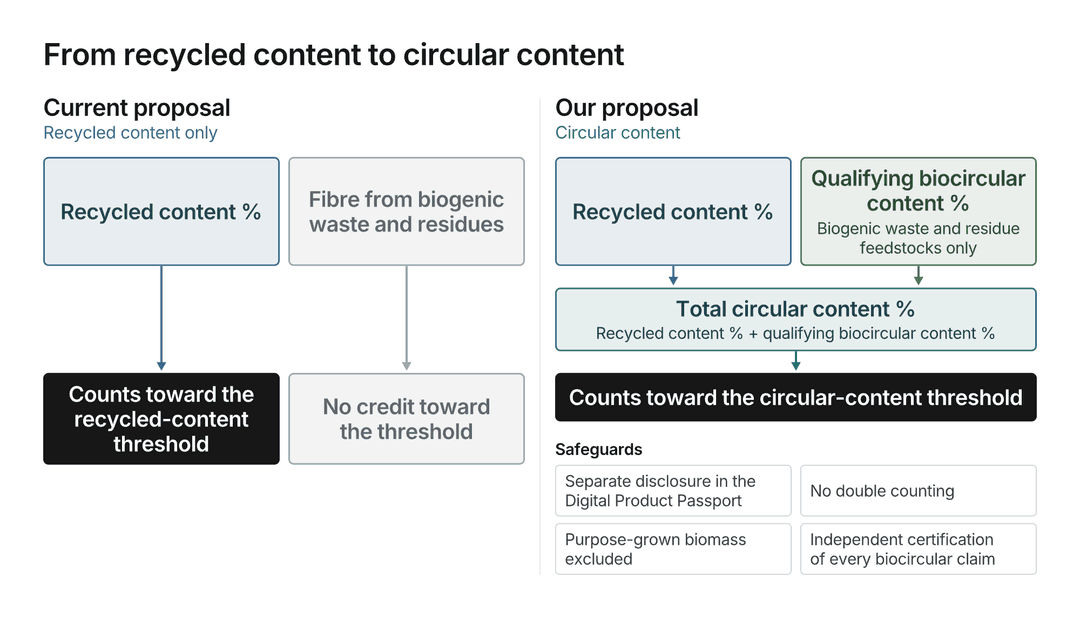
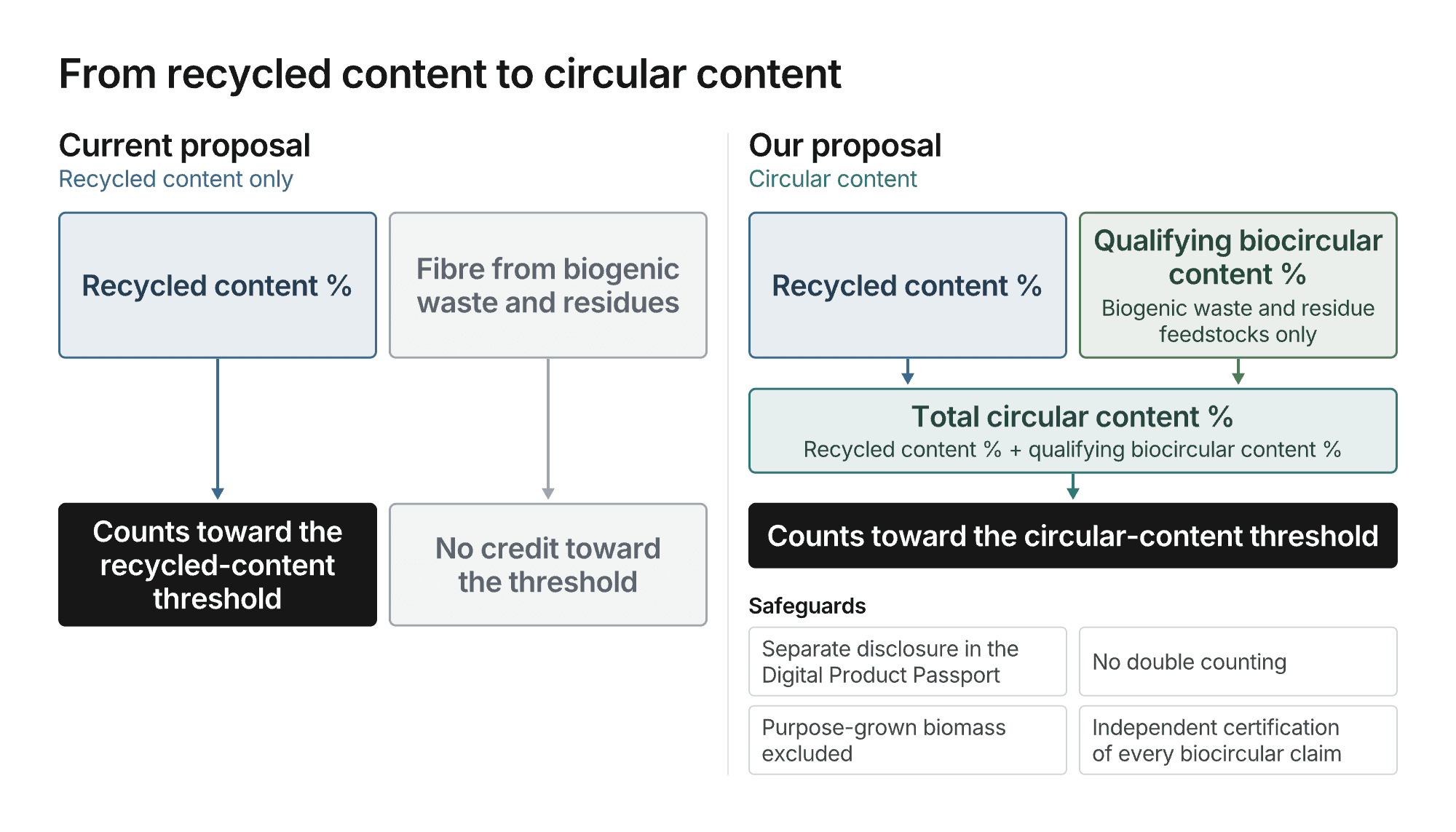
We propose broadening the recycled-content requirement into a circular-content requirement. Recycled content and qualifying biocircular content would both count toward the minimum threshold, and each would be disclosed separately in the Digital Product Passport. We ask the Commission to:
- Integrate biocircular content: let qualifying biocircular content, derived strictly from biogenic waste and residue feedstocks, count toward the circular-content threshold alongside recycled content, with the two disclosed separately.
- Establish the passport fields: create dedicated Digital Product Passport fields for both recycled and biocircular content, as the foundation for EPR fee modulation and green public procurement, whatever the threshold decision.
- Preserve future eligibility: if full threshold inclusion cannot yet be finalised, identify biocircular content as a candidate subcategory for threshold development in a future revision.
Safeguards keep this proposed change narrow. Only genuine waste and residue feedstocks qualify, and crops grown for the purpose are excluded. Every claim needs independent certification, and no material fraction can be counted as both recycled and biocircular. The legal basis is already in the ESPR: Annex I lists both “use or content of recycled materials” and “use or content of sustainable renewable materials” as product parameters, so no amendment to the regulation is needed.

Get in touch
We invite our members and partners to share the paper on their own channels. We welcome discussion with policymakers and with organisations working on the delegated act.
Contact us at biosphere-circulation@spiber.inc
About the BioCircular Materials Alliance
The BioCircular Materials Alliance (BCMA) was founded to harness the transformative power of biology to accelerate the global transition toward a circular future. By bringing together leading brands, manufacturers, and innovators, the Alliance seeks to enable regeneration of biobased waste from textiles, agriculture, and forestry into valuable materials through microbial fermentation and other advanced processes.
Share this paper